Hip pain: causes, treatment and physio in London
By Geoff Scott, Founder & Senior Physiotherapist, Hauora
By Geoff Scott, Senior Physiotherapist and founder of Hauora, former Head of Medicine and Sports Science at Tottenham Hotspur. Reviewed by Jason Oliveira, Senior Physiotherapist. Published 23 November 2026.
What causes hip pain, and can physiotherapy help?
Most hip pain comes from a handful of causes: hip osteoarthritis, irritated gluteal tendons on the outside of the hip, hip impingement and labral problems, groin strains, or pain referred from the lower back. A thorough physiotherapy assessment usually pinpoints which one, and most people get better with hands-on treatment and a progressive strength plan, without needing surgery.
Hip pain is one of the most common problems we see at Hauora, our sports physiotherapy and rehabilitation clinic in Primrose Hill, London. We treat it in everyone: runners on Primrose Hill and in Regent’s Park, footballers, dancers, gymnasts and other athletes, people whose hip has started to ache on walks or at night, and patients preparing for or recovering from hip surgery. Whoever you are, we bring what we learned in elite sport: a precise diagnosis, measured strength work and a clear plan, with progress you can see from week to week.
Hip pain at a glance
- It’s common. In a large US national survey, 14.3% of adults aged 60 and over reported significant hip pain on most days over the previous six weeks.
- Hip osteoarthritis affects an estimated 10.9% of people aged 45 and over in England.
- Outside-of-hip pain (gluteal tendinopathy, often called trochanteric bursitis) affected 15% of women aged 50 to 79 on one side and 8.5% on both sides, compared with 6.6% and 1.9% of men.
- Scans don’t tell the whole story. In the Framingham study, only about 16% of hips with frequent pain showed arthritis on X-ray, and only about 21% of hips with arthritis on X-ray were frequently painful.
- Labral tears are common without pain: MRI found them in 69% of hips in volunteers with no hip symptoms.
- Exercise beats an injection for outside-of-hip pain. In the LEAP trial, 77% of patients rated their hip a success after an eight-week education and exercise programme, against 58% after a steroid injection and 29% with wait-and-see. At one year the figures were 78%, 57% and 52%.
- Hip impingement: in the UK FASHIoN trial, both personalised physiotherapy and keyhole surgery improved hip-related quality of life; surgery added 6.8 points on a 100-point scale at 12 months.
- Steroid injections into an arthritic joint give short-term relief of around 2 to 10 weeks, and NICE advises using them to support exercise.
- Exercise is first-line for hip arthritis in UK guidance. A 2026 Cochrane review found the average benefit is modest, which is why a programme needs to be individual, well-dosed and progressed, not a generic sheet.
- Cost at Hauora: 45-minute assessment £155; 90-minute Hauora+ athlete session £250.
What are the most common causes of hip pain?
Hip pain is a symptom, not a diagnosis. Getting the cause right is the most important step, because each one needs a different plan. These are the conditions we see most often.
Hip osteoarthritis
Osteoarthritis is one of the most common causes of hip pain in people over 45. It typically causes a deep ache in the groin or the front of the hip, stiffness first thing in the morning that eases within about half an hour, difficulty putting on socks or getting in and out of a car, and pain on longer walks. NICE advises that it can be diagnosed from symptoms and examination, without a scan, in people aged 45 and over with typical activity-related pain. It isn’t simply wear and tear: the joint is living tissue that responds to load, and strength, body weight and activity levels all change how it feels.
Gluteal tendinopathy and trochanteric bursitis
Pain on the outside of the hip, often worse when you lie on that side at night, climb stairs, stand on one leg or sit with your legs crossed, usually comes from the gluteal tendons where they attach to the bony point of the hip (the greater trochanter). Doctors call this greater trochanteric pain syndrome. It’s often labelled trochanteric bursitis, but the tendons are usually the main source of pain. It is especially common in women, affecting around one in four women over 50, and it responds well to the right combination of load management and progressive strengthening.
Hip impingement (FAI syndrome) and labral tears
Femoroacetabular impingement (FAI) syndrome happens when the shape of the ball (cam) or the socket (pincer) causes the joint to pinch in deep bending and rotation. It’s a common cause of groin pain in active people in their teens, twenties and thirties, especially in football, hockey, martial arts and dance. International consensus defines FAI syndrome as a combination of symptoms, examination findings and imaging, never imaging alone. A tear in the labrum (the rim of cartilage around the socket) can come with it, but labral tears are also common in people with no pain, so a tear on a scan isn’t automatically the cause.
Groin pain in athletes
In sport, hip and groin pain overlap. The Doha agreement, the international classification used in sports medicine, groups athletic groin pain into adductor-related, iliopsoas-related (hip flexor), inguinal-related, pubic-related and hip-related pain. That is exactly how we examine it, because each has a different rehab plan, and many athletes have more than one. Read more in our guide to groin injuries in footballers.
Hip flexor strains and tendinopathy
Pain at the front of the hip when you lift your knee, sprint or kick often comes from the iliopsoas or the rectus femoris. These usually respond well to graded loading and a planned return to running and kicking.
Pain referred from the lower back
The lower back can send pain into the buttock, the side of the hip and down the leg. Sciatica and some disc problems are often mistaken for hip pain, which is why we always check the spine. Our physiotherapists are trained in the McKenzie Method, which helps to tell back-related pain from true hip pain. See our guide to lower back pain treatment.
Bone stress injuries in runners
Groin or hip pain that builds with running and starts to ache at rest or at night, especially after a jump in mileage, can be a stress reaction in the neck of the femur. This needs prompt medical imaging and must not be run through. Our running physio guide explains how we plan a safe return.
Before and after hip surgery
We also help patients prepare for and recover from hip replacement and hip arthroscopy, working closely with their surgeons. See our hip replacement prehab and rehab guide. Surgeons and GPs can refer a patient directly.
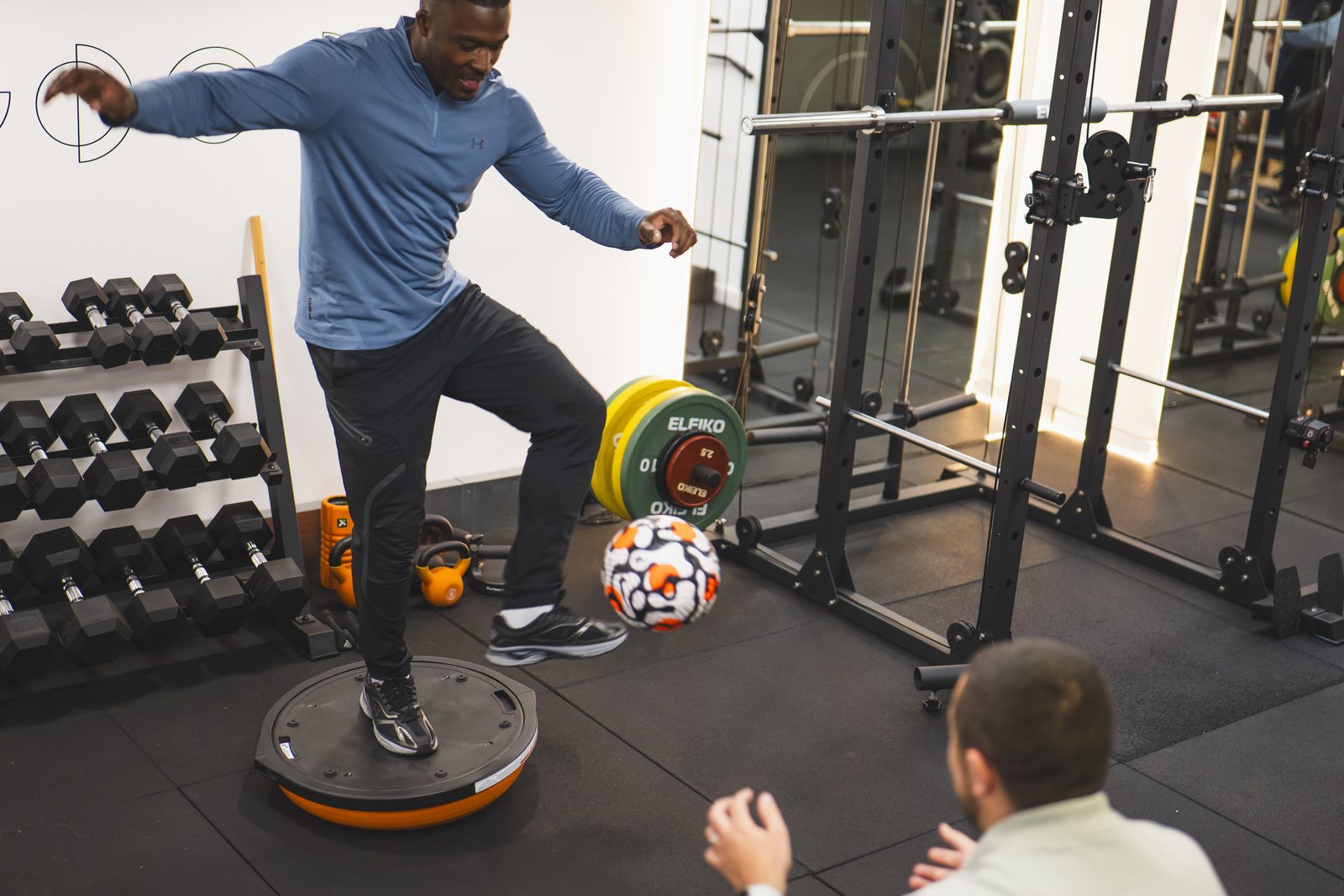
What does the location of your hip pain tell you?
- Groin or front of the hip: often the hip joint itself (osteoarthritis, impingement or the labrum), or the hip flexors and adductors.
- Outside of the hip: usually the gluteal tendons, sometimes pain referred from the lower back.
- Buttock: often the lower back, the sacroiliac joint or the deep gluteal muscles, and less often the hip joint.
- Thigh or knee: hip problems can refer pain to the knee. In a child or teenager with a limp and thigh, knee or hip pain, a slipped capital femoral epiphysis (SUFE) must be ruled out urgently.
When is hip pain serious?
Most hip pain is not dangerous. Get urgent medical help, at A&E or from your GP the same day, if you have:
- hip pain after a fall, especially if you can’t put weight on the leg or it looks shorter or turned outwards
- a hot, swollen, very painful hip with a fever or feeling unwell
- a child or teenager with a new limp, or hip, thigh or knee pain
- severe pain at night or at rest that doesn’t ease, unexplained weight loss, or a history of cancer
- a runner’s groin pain that keeps getting worse and aches at rest
- back pain with numbness around the groin or saddle area, or new bladder or bowel problems
If we find any of these at your assessment, we’ll arrange the right medical review straight away.
How do we assess hip pain at Hauora?
Your first appointment is a 45-minute assessment with one of our senior physiotherapists. We aim to answer three questions: what is causing your pain, what is holding your hip back, and what will get you better.
- Your story. Where the pain is, what sets it off, how you sleep, your sport and work, previous injuries and any scans you’ve had.
- Movement. How your hip bends, rotates and extends compared with the other side, plus the clinical tests used in sports medicine for impingement, labral and tendon pain.
- Strength and control. The strength of your glutes, hip rotators, adductors and hip flexors, single-leg balance and squat control, and for athletes, hopping and change-of-direction tests where appropriate.
- The rest of the chain. A lower back screen, your knee and foot, and how you walk or run.
- Imaging only when it would change the plan. X-rays and MRI can mislead, because many findings appear in people with no pain, so we arrange or recommend scans when the clinical picture calls for it.
- Your plan. A diagnosis in plain English, a written plan and timeline, and what success will look like.
What is the best treatment for hip pain?
The best treatment depends on the cause, but nearly every plan we build combines hands-on treatment to restore movement, progressive strengthening, smart load management and a clear route back to the activities you care about.
Hands-on treatment to improve mobility
Joint mobilisation, soft tissue work and assisted stretching can ease pain and restore movement, especially in a stiff, arthritic hip. NICE recommends manual therapy for hip osteoarthritis alongside exercise rather than on its own, and that is exactly how we use it: hands-on treatment opens a window of easier movement, and the exercise makes the gain last.
Strength: the treatment that lasts
Strength is the backbone of hip rehab. We build your glutes, hip rotators, adductors and trunk progressively, from controlled exercises in the clinic to loaded work in the gym and, for athletes, to running, cutting and kicking. Exercise is the first-line treatment for hip osteoarthritis in UK guidance, and for outside-of-hip pain a physiotherapist-led education and exercise programme beat both a steroid injection and wait-and-see at one year in the LEAP trial. Research results are averages: the difference comes from choosing the right exercises, dosing them properly and progressing them every few weeks.
Load management and education
With gluteal tendon pain in particular, what you avoid matters as much as what you do. Crossing your legs, standing with your weight hanging on one hip, lying on the painful side and some stretches all compress the tendon. Small changes, such as a pillow between your knees at night, often bring quick relief while the strength work does its job.
Getting you back to running and sport
For runners and athletes we plan a staged return: walk-run, then hills and speed, then sport-specific drills and change of direction, guided by your symptoms and strength tests rather than the calendar. Our return-to-sport testing guide explains the tests we use.
Injection therapy and onward referral
If your hip doesn’t improve as expected with physiotherapy, rehabilitation and strengthening alone, we’ll talk you through the next options and refer you to a trusted hip specialist or sports physician. Injection options include a steroid injection, which can calm pain for several weeks and make your exercise easier, platelet-rich plasma (PRP) and hyaluronic acid, usually given under image guidance. Your specialist will advise which, if any, suits your hip, and we keep working alongside them on your rehab. For hip impingement, the UK FASHIoN trial found that both physiotherapy and surgery helped, so many patients start with a personalised programme and keep surgery as an option. For advanced osteoarthritis, hip replacement is a highly successful operation, and we help patients prepare for it and recover from it.
MBST at our Primrose Hill clinic
MBST magnetic resonance therapy is available at our Primrose Hill clinic, and many patients with hip pain ask us about it. It’s a calm, painless, non-invasive treatment, and research is growing. We’ll talk you through whether it’s worth considering alongside your rehab. Read more in our MBST guide.
From elite sport to everyday hips
In professional football, hip and groin problems are managed with close daily attention to load, strength and movement, because rushing them can cost a player months. The same principles work for everyone: find the true source of the pain, measure what is weak, load the tissue progressively and return to activity in stages. We use that approach with Olympic athletes, including gymnasts and runners, and with patients who simply want to walk on Hampstead Heath or play with their grandchildren without pain.
How long does hip pain take to get better?
- Gluteal tendon pain: in the LEAP trial, most patients reported success after an eight-week programme of 14 sessions, and the benefit held at one year.
- Hip osteoarthritis: give a well-planned strength programme time to work. NICE notes that sticking with exercise long term increases the benefits, reducing pain and improving function and quality of life.
- Hip impingement and labral pain: a structured, progressive physiotherapy programme is usually tried before deciding on surgery, and in UK FASHIoN both approaches improved symptoms at 12 months.
- Muscle strains around the hip and groin: from a couple of weeks for minor strains to longer for more significant ones, guided by strength and sport-specific testing.
These are typical patterns, not promises. We review your progress at every session and change the plan if you’re not on track.
Top tips for hip pain
- Keep moving. Walking, cycling and swimming within comfort are usually good for sore hips. Mild discomfort that settles by the next day is generally fine.
- Don’t cross your legs or hang on one hip if the pain is on the outside of your hip.
- Sleep smarter. Try a pillow between your knees, or sleep on your back or your pain-free side.
- Strengthen, don’t just stretch. Stretching across the outside of the hip can aggravate tendon pain.
- Build running gradually. Avoid sudden jumps in distance or speed.
- Manage your weight if you need to. NICE lists weight management, alongside exercise, as a core treatment for osteoarthritis.
- Don’t let a scan scare you. Many scan findings are normal for your age and don’t cause pain.
- Get it checked early. Hip pain that lasts more than a couple of weeks, or keeps coming back, is easier to sort out with a clear diagnosis.
How we treat hip pain at Hauora
Book a 45-minute assessment (£155) with one of our senior physiotherapists. You’ll leave with a diagnosis, hands-on treatment where it helps, a written strength plan and a timeline. Geoff Scott stays closely involved in every patient’s care, and Jason Oliveira and the team deliver it. Athletes can book the 90-minute Hauora+ athlete session (£250) for a more detailed movement, strength and return-to-sport assessment. We also offer strength and conditioning and performance nutrition, and MBST is available on site.
If you need an injection, a scan or a surgical opinion, we’ll refer you to trusted consultant colleagues and keep working alongside them. Using health insurance? Many of our patients claim back the cost of their sessions, including Bupa Global and AXA Global members. Cover varies by insurer and policy, so please check with yours before your first appointment. We’ll give you everything you need to make your claim. See our hip pain page and all our fees, or request an appointment online at hauora.com/book.
Frequently asked questions
What is the most common cause of hip pain?
It depends on your age and activity. In people over 45, hip osteoarthritis and gluteal tendon pain on the outside of the hip are the most common causes. In younger, active people, hip impingement, labral problems and groin strains are more common. At any age, pain from the lower back is often mistaken for hip pain.
How do I know if my hip pain is serious?
Get urgent medical help if your hip hurts after a fall and you can’t put weight on it, if the hip is hot and swollen and you have a fever, if a child or teenager develops a limp, or if the pain is severe at night or at rest. Most other hip pain is not dangerous and responds well to physiotherapy.
Is walking good for hip pain?
Usually, yes. Walking keeps the hip moving and is good for joint health. Mild discomfort that settles by the next day is generally fine. If walking makes your pain build day after day, shorten the distance, choose flatter routes and get assessed so we can adjust your plan.
Why does my hip hurt when I lie on my side at night?
Pain on the outside of the hip when you lie on that side is a classic sign of gluteal tendinopathy, often called trochanteric bursitis. Lying on the sore side squashes the tendon against the bone. A pillow between your knees, sleeping on your back and a targeted strength programme usually help.
Can hip arthritis be treated without surgery?
Yes, for most people. NICE recommends exercise, education and weight management as the core treatments, with hands-on therapy alongside exercise and injections for short-term relief when needed. Most people with hip osteoarthritis will not need surgery, and hip replacement remains an excellent option if pain and function stay poor despite good treatment.
Do I need an X-ray or MRI for hip pain?
Often not at first. Hip osteoarthritis can be diagnosed from your symptoms and examination, and scans often show changes such as labral tears in people with no pain at all. We recommend imaging when it would change your treatment, for example if we suspect a stress fracture or you are considering surgery.
Should I see a physiotherapist or a doctor for hip pain?
For most hip pain, a physiotherapist is an excellent first step, and you don’t need a GP referral to see us. If you need medication, an injection, a scan or a surgical opinion, we’ll refer you to the right doctor or consultant. Some insurers ask for a GP referral before they cover physiotherapy.
How much does hip physiotherapy cost at Hauora?
A 45-minute assessment with a senior physiotherapist costs £155, and the 90-minute Hauora+ athlete session costs £250. Many patients claim back the cost on health insurance, including Bupa Global and AXA Global members. Cover varies by insurer and policy, so please check with yours before your first appointment.
Related reading
- Lower back pain treatment: expert physio in London
- Sciatica: causes, treatment and how long it lasts
- Groin injuries in footballers: treatment and rehab
- Anterior hip replacement recovery: prehab and rehab guide
- Running physio London: injuries, rehab and assessment
- Strength training after 40: how to start safely
Hip pain physio in Primrose Hill, St John’s Wood, Regent’s Park and Marylebone
Whether your hip aches on walks, keeps you awake at night or is stopping you from running or playing sport, book an assessment at Hauora, an independent physiotherapy clinic at 44 Gloucester Avenue, Primrose Hill, London NW1 8JD. We’re about five minutes’ walk from Chalk Farm station, close to Camden Town, and easy to reach from St John’s Wood, Regent’s Park, Marylebone, Belsize Park, Swiss Cottage, Hampstead, Kentish Town and Maida Vale. Request an appointment online at hauora.com/book, call 020 4541 8924 or email contact@hauora.com.
This article is general information, not a diagnosis. If you’re injured or unwell, see a doctor or physiotherapist.
Sources
- Christmas C, et al. How common is hip pain among older adults? Results from the Third National Health and Nutrition Examination Survey. Journal of Family Practice, 2002
- Arthritis Research UK (now Versus Arthritis). Musculoskeletal calculator: osteoarthritis prevalence estimates, England (hip osteoarthritis in people aged 45 and over)
- Segal NA, et al. Greater trochanteric pain syndrome: epidemiology and associated factors. Archives of Physical Medicine and Rehabilitation, 2007
- Kim C, et al. Association of hip pain with radiographic evidence of hip osteoarthritis: diagnostic test study. BMJ, 2015
- Register B, et al. Prevalence of abnormal hip findings in asymptomatic participants: a prospective, blinded study. American Journal of Sports Medicine, 2012
- Mellor R, et al. Education plus exercise versus corticosteroid injection use versus a wait and see approach on global outcome and pain from gluteal tendinopathy (LEAP): randomised clinical trial. BMJ, 2018
- Griffin DR, et al. Hip arthroscopy versus best conservative care for the treatment of femoroacetabular impingement syndrome (UK FASHIoN): a multicentre randomised controlled trial. Lancet, 2018
- Weir A, et al. Doha agreement meeting on terminology and definitions in groin pain in athletes. British Journal of Sports Medicine, 2015
- NICE. Osteoarthritis in over 16s: diagnosis and management (NG226), 2022
- NICE. Impact report: osteoarthritis
- Cochrane. Exercise for osteoarthritis of the hip (review update, July 2026)
- Krpan D, et al. Nuclear magnetic resonance therapy for deep-tissue biophysical stimulation: an integrated clinical and molecular analysis. British Medical Bulletin, 2026; 160(1): ldag045